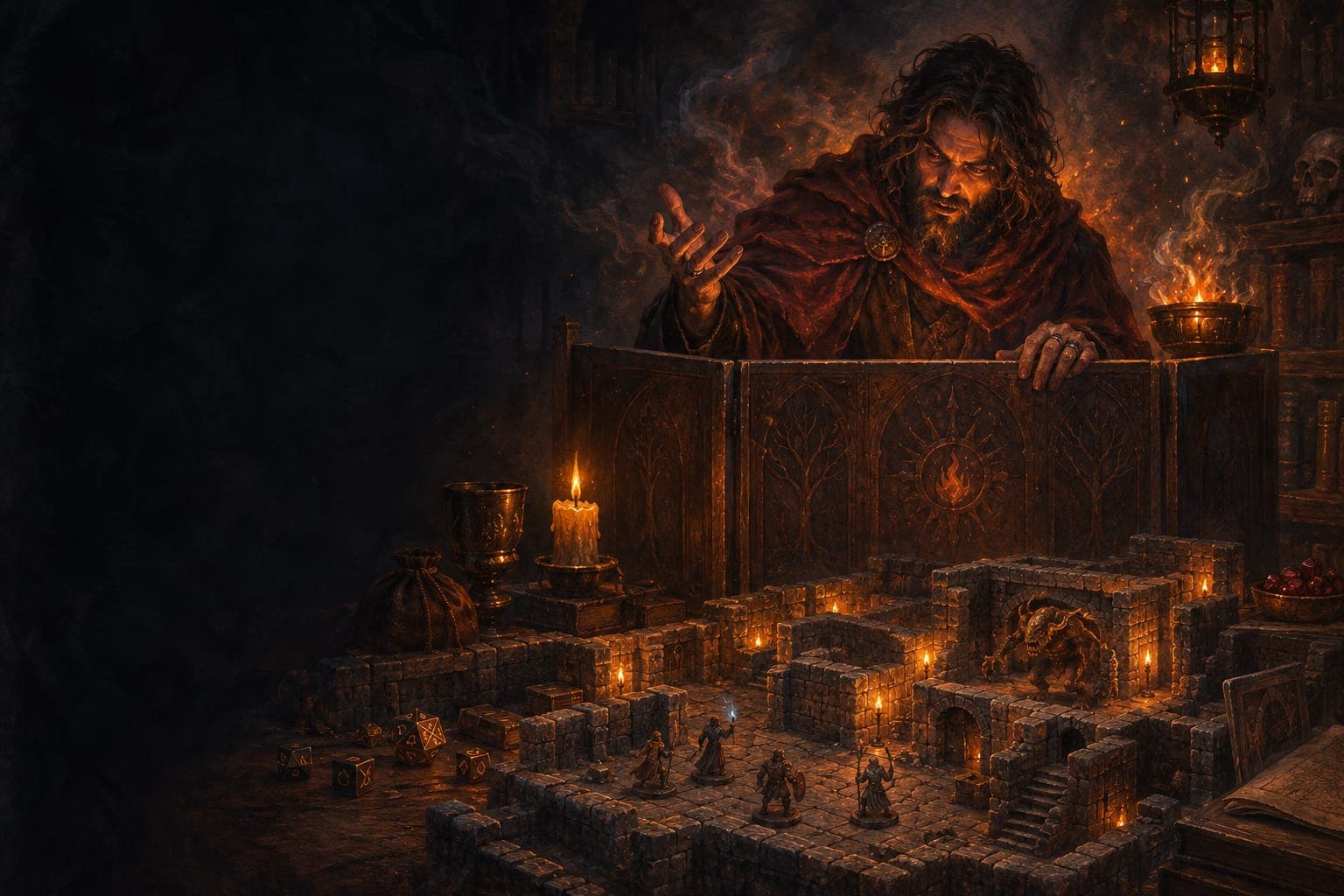
AI dungeon master: what it does at the table, and its limits
An AI dungeon master is an AI that runs a role-playing game for your group. During a game night it describes each scene, speaks for every other character, listens to what your characters do and asks for a dice roll when an action is risky. It has limits: in Role is Easy it never chooses the dice result, it only hears you when you talk to it, and it cannot see your faces.
What people mean by "AI dungeon master"
In Dungeons & Dragons (D&D), the person who runs the game is the "Dungeon Master". Most other role-playing games say Game Master, or GM. It is the same job. So when people search for an "AI dungeon master", they usually want one thing: a way to play a fantasy role-playing game when nobody in the group wants to run it.
Role is Easy gives you an AI Game Master. It is not D&D, and it is not made or supported by the company that publishes D&D. It has its own rules and its own dark fantasy world. You can read how the two compare in an AI Game Master for D&D-style games.
This guide does not ask if an AI can do the job. It shows what the AI actually does, moment by moment, during a real game night. For the bigger question, read can an AI run a tabletop RPG?.
A game night, step by step
Here is what the AI Game Master does from the first minute to the last. Your group sits together on camera and voice in one browser window, and everyone sees the same 2.5D map.
- It sets the scene. The GM describes where you are, with voice and text. The map moves to show the place.
- It asks what you do. It does not give you a fixed list of choices. You say what your character does, in your own words.
- It listens when you talk to it. You tap the GM microphone or you type. When you talk to your friends, the GM does not treat it as an action.
- It decides if a roll is needed. If the action is easy, it simply happens. If it is risky, the GM names the check and how hard it is.
- The rules engine rolls. A separate rules engine rolls the dice on the server. Everyone sees the dice roll on the table.
- It tells you what changed. The GM describes the result. A door opens, a person gets angry, or the path is now safe.
- It plays everyone else. Shopkeepers, guards, strangers and monsters all talk and act through the GM, each with their own goals.
- It writes things down. A campaign journal records the people, places, promises and debts. Next time, the GM uses it to continue the story.
Fights work a little differently
Most of the game is open. Anyone can speak when they have an idea, like at a real table. When a fight starts, the game changes to turns, so everyone knows whose move it is.
In a fight, the GM still describes what happens and what the enemies try to do. The rules engine still handles every roll and every point of damage. Your character's figure stands on the map, so you can see where everyone is.
What the AI will never do
Some limits are there on purpose. They keep the game fair and keep the players in control.
- It never chooses the dice result. It can only ask for a roll. So asking nicely, or arguing well, never gets you a better number. Read are dice fair when an AI runs the game?.
- It never changes your health, your gear or your sheet because you asked it to. Only the rules can do that.
- It never listens all the time. It only hears you when you tap its microphone, and the screen always shows which channel is on.
- It never decides for your character. It can describe what happens to you, but what you try is always your choice.
- It never uses D&D rules, characters or adventures. You cannot import a D&D character. You make your character inside the platform.
Its honest limits
An AI Game Master is a good storyteller, but it is not a person at your table. Know these limits before you play.
It cannot see your faces. A human GM notices when a player is bored, upset or lost. The AI only knows what you say to it. So say it: "Can we have less fighting tonight?" or "I want more time to talk to people."
It only knows what you tell it. If your plan has three steps, say all three. Short, clear sentences work best.
It is not perfect. Like any AI, it can sometimes describe a small detail in a different way than before. The journal helps a lot, because it keeps the important facts. If something feels wrong, say so, like you would with a human GM.
It speaks two languages. You can play in Spanish or English, not in other languages yet.
It works best on a laptop, desktop or tablet. A phone layout is not ready yet.
How to get the best from an AI Game Master
Ready to try it? Look at campaigns made by other players to pick a story, and check the prices. The organiser pays for the group's seats. If you want to build a world of your own one day, read about the World Forge.
- Talk to your friends first. Agree on what kind of night you want: danger, mystery or lots of talking.
- Describe the how, not only the what. "I climb on the side away from the wind" gives the GM more to work with than "I climb".
- Ask questions. "What do I see on the table?" is an action too. The GM answers.
- Use the journal. Before a session, read it for a minute to remember where you stopped.
Questions and answers
Is an AI dungeon master the same as a chatbot?
No. A chatbot only writes text, and it can make up dice results. In Role is Easy, the AI tells the story, but a separate rules engine rolls the dice and keeps the game state. You also play with your friends on camera, not alone in a chat.
Do I need to know any rules?
No. You say what your character does. The Game Master decides when a roll is needed and tells you what happened. Your character sheet is always there if you want to see the numbers.
Can I play with an AI dungeon master alone?
Yes. Role is Easy is made for groups of friends, but you can also play solo adventures. See the prices for the plan for one player.
Does the AI remember what happened last session?
Yes. A campaign journal records who you met, where you went and what you promised. The Game Master uses it in the next session, and you can read it too.